
 Canada
 Brazil
 Germany
 France
 Italy
 Switzerland
 Sweden
 Spain
 Great Britain
 Norway
 Russia
 South Africa
 Japan
 New Zealand
 Australia

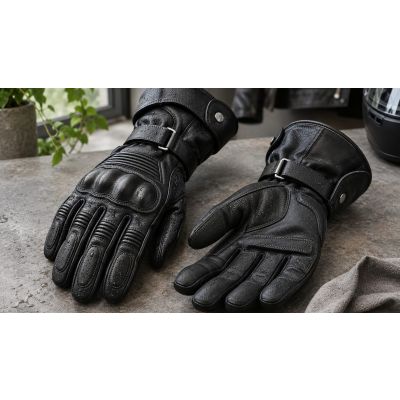
Short answer: leather on its own is water resistant at best. It soaks, then dries stiff. A glove is waterproof only when it has a membrane liner between the leather and your hand, and even then water can enter at the cuff, the seams or the stitching during a long ride. Treat any "waterproof" claim with care and ask what part of the glove provides it.
Why leather is not waterproof
Leather is skin, and skin is made of fibers with tiny gaps between them. Finishes and oils slow water, but they do not seal the material. Wet leather absorbs water, gets heavier and loses some of its softness. If it dries too fast or without conditioning, it can end up stiff and, over time, prone to cracking. Our guide to rain and leather goes through what happens and what to do.
That does not make leather a bad choice for wet weather. It means you should know what a glove actually does and does not do before you rely on it.
Membrane liners
A membrane is a thin layer, built into the glove between the outer shell and the inner lining. Its job is to stop liquid water from reaching your hand while allowing some water vapor from sweat to escape. Makers use their own brand names for these, so check the manufacturer's documentation to see what the product claims.
Trade-offs to expect:
- Breathability. A membrane breathes less than an open lining. Hands can get damp from the inside on long or warm rides.
- Feel. The extra layer can make the glove slightly thicker and reduce feel on the controls.
- Drying. If water does get in, a membrane glove can take longer to dry because the water is trapped between layers.
Treated leather
Some gloves are treated with wax, oil or a spray finish to make the leather shed water. This helps in light rain and splash, but the treatment wears off with use, washing and drying. Reapply according to the product's instructions, and test on a hidden area first. Treated leather is water resistant, not waterproof.
What fails first
| Weak point | Why water gets in | What to check |
|---|---|---|
| Cuff | Water runs down the sleeve and into the glove | Wear the cuff under the sleeve cuff or seal it with a strap |
| Seams | Needle holes let water through the membrane | Look for sealed or taped seams, if the maker states them |
| Wrist closure | A loose strap leaves a gap | Cinch the closure snug |
| Fingertips and finger seams | Flex points wear first | Check for wear over time |
| Long rides | Water finds a route through any glove eventually | Carry a spare pair or liner |
A glove can leak even when it is described as waterproof, so a good fit and a good sleeve overlap matter as much as the membrane.
Care after rain
- Take the gloves off and wipe off water and dirt with a soft cloth.
- Stuff them loosely with paper or leave them open so air can get inside. Do not stuff tight.
- Let them dry at room temperature, away from a radiator, hair dryer or direct sun. Heat dries leather too fast and makes it stiff.
- When fully dry, apply a thin layer of leather conditioner suited to the finish, according to the product's instructions.
- Check seams and stitching for damage before the next ride.
Our leather jacket in the rain article covers the same principles for jackets.
Choosing for your riding
- Commuting. You ride in the rain whether you like it or not. A membrane glove with a long cuff is worth considering.
- Touring. Long days in changing weather suit a membrane glove or a spare pair.
- Track. Most track riding avoids rain. If you ride a wet session, check what the event allows and how the gloves handle wet grip.
Our summer versus winter gloves guide covers how liners, cuffs and perforation fit into a seasonal set.
What to ask about any glove
- Does it have a membrane, and where does it sit in the glove?
- Are the seams sealed or taped?
- How long is the cuff, and does it fit over or under the sleeve?
- Does the glove meet a protective standard such as EN 13594? See our explainer on EN 13594 gloves.
- How should it be dried and conditioned?
Waterproofing should never replace protection. If a glove has a membrane but no knuckle or palm protection, it is not a good choice for a rider.
If you are unsure
If you do not know how a glove will handle a wet ride, assume it will let water in. Carry a spare pair or a waterproof overglove in a pannier or pocket, and plan stops where you can dry your hands. Official road-safety bodies publish advice on riding in wet weather, including increased stopping distances and reduced grip; read their current guidance before you ride.
See our gloves buying guide for the protection features to check first. For gloves built to your hand and use, see custom motorcycle gloves. Our gloves have no waterproof or rain liner, and leather gear is not waterproof, so carry a rain layer or waterproof overglove for wet rides.
What this means for the gloves you already own
If you already ride in leather gloves, you do not need to throw them out. Use them in dry weather and light drizzle, add a waterproof overglove or a spare pair for planned wet rides, and give them the care routine above after each soaking. Check the lining and stitching once a season. If the gloves have been wet many times, the leather may have stiffened or the seams opened, and a worn glove protects less in a fall than a sound one.
For riders who commute year round, treat waterproofing as a system: gloves, cuff overlap, sleeve and a plan for drying them overnight. Putting damp gloves back on in the morning is the fastest way to a cold ride, so a second pair that dries while you wear the first can be worth the cost.
FAQs
Are leather motorcycle gloves waterproof?
Not by themselves. Leather is water resistant at best. A membrane liner provides waterproofing, but seams, cuffs and long rides can still let water in.
Do waterproof gloves breathe?
Less than non-membrane gloves. Membranes let some vapor out, but your hands can still get damp on long rides.
How do I waterproof leather gloves?
You can use a wax or spray made for leather to improve water resistance. Test on a hidden area first and follow the product's instructions. It will not make the glove fully waterproof.
Why do my waterproof gloves leak?
Common causes are water running down the sleeve into the cuff, worn or unsealed seams, a loose wrist closure and a glove that has been worn for a long wet ride.
How do I dry wet motorcycle gloves?
Dry them at room temperature, loosely stuffed with paper, away from heat sources. Condition them once dry.
Are rain covers worth it?
They can be a cheap backup for unexpected rain. Make sure they fit over your gloves without limiting control.
Look at custom motorcycle gloves, and add a rain layer or waterproof overglove for wet-weather use.