 Canada
  Brazil
  Germany
  France
  Italy
Italy  Switzerland
  Sweden
  Spain
Spain  Great Britain
  Norway
  Russia
  South Africa
  Japan
Japan  New Zealand
  Australia
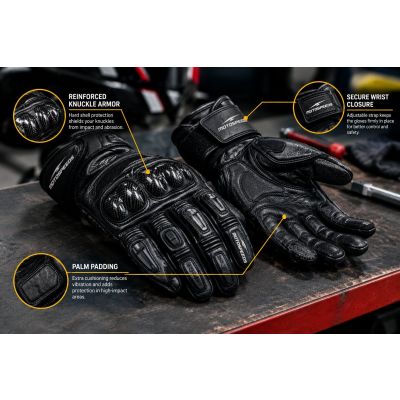
Three pairs of racing gloves can look similar on a shelf: one snug at the wrist, one with bulky armor, one from an unfamiliar brand. The differences that matter are the protection standard, the leather, the construction and above all the fit. This guide explains what to check when choosing motorcycle racing gloves for track riding.
Key Takeaways
- EN 13594:2015 defines two levels of motorcycle glove; Level 2 requires knuckle impact protection and a longer cuff.
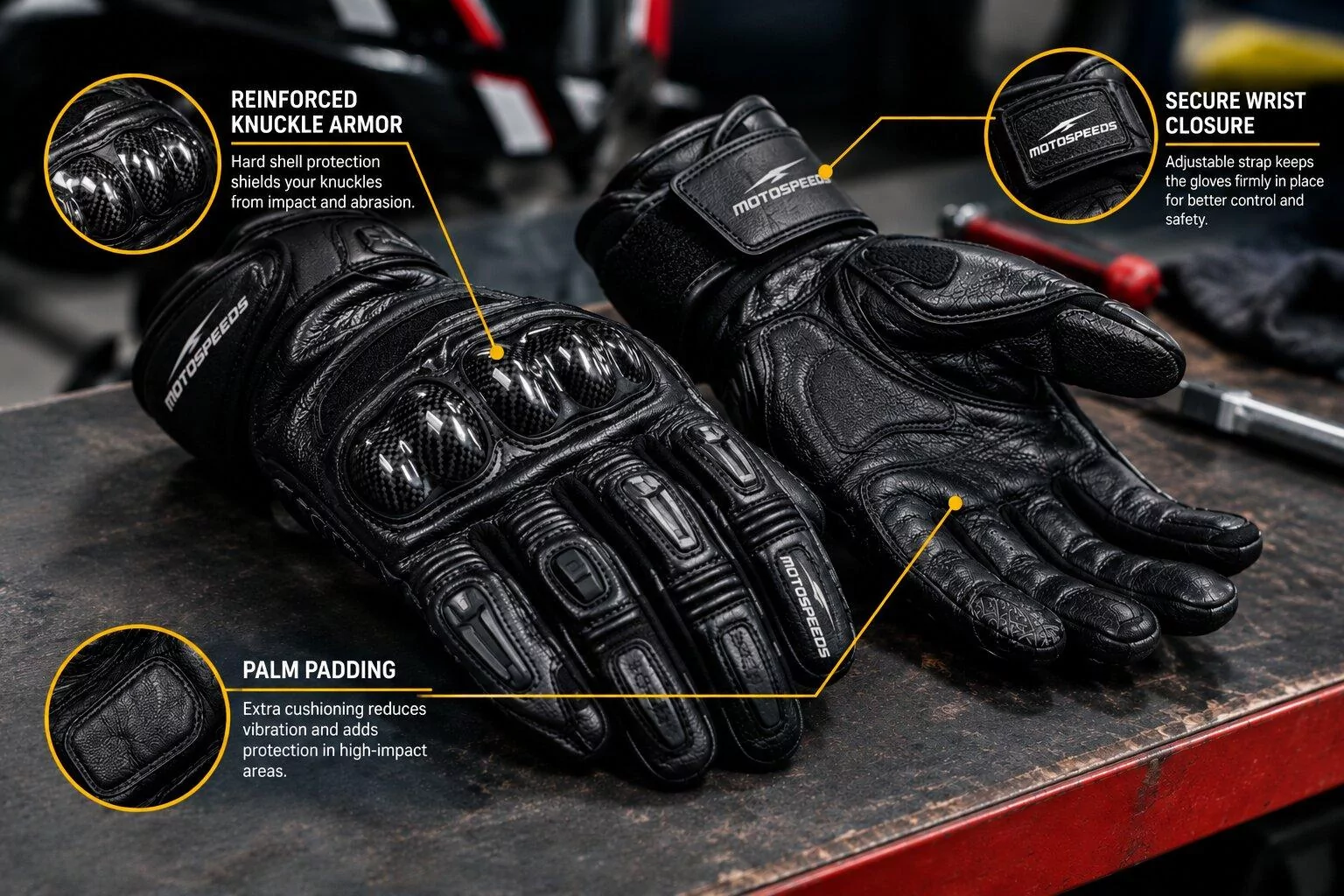
- Track riding calls for gloves built for racing speeds, with reinforced palm and knuckles and a secure wrist closure.
- Fit decides whether the armor stays where it is needed, so gloves should be snug without numbness or pressure points.
- Leather type, thickness and stitching determine abrasion resistance more than the number of features listed.
- Check the rules of the track day or series, which may set their own glove requirements.
What the Standard Says
Motorcycle gloves sold in Europe are tested to EN 13594:2015. SATRA's summary of the standard describes two performance levels: Level 1 gives protection with low ergonomic penalties, and Level 2 gives greater protection with possible weight and restriction penalties. Knuckle impact protection is optional for Level 1 and mandatory for Level 2, and the minimum cuff length measured from the wrist is 5 mm for Level 1 and 50 mm for Level 2.
According to SATRA, palm abrasion is tested on the Cambridge abrasion machine, while Intertek's testing overview lists tear, cut and ergonomic and sizing assessments. A CE marking and a glove's stated level show which tests it passed, but not how well it fits a particular hand, so fit still has to be checked separately.
Match the Glove to the Riding
Racing gloves differ from street and commuter gloves in priorities. They emphasize protection over ventilation, with thicker leather, more armor and reinforced stitching. Street gloves balance protection with comfort and airflow for long rides, and commuter gloves focus on dexterity for daily use.
Track days and club racing: race-specific gloves with reinforced palm sliders, knuckle protection and a wrist closure that stays fastened in a slide.
Spirited road riding with occasional track days: mid-range sport gloves that combine solid armor and wrist support with better ventilation.
Touring and commuting: street gloves with impact protection, airflow and enough dexterity to operate the controls.
Safety Features to Check
Armor and Placement
Armor placement matters as much as armor thickness. A well-designed glove protects the heel of the palm, the knuckles and the outer edge of the hand, and the armor stays in place without restricting grip.
Wrist Support
The wrist is exposed when a crash forces the hand backwards. According to SATRA, EN 13594 sets a minimum cuff length and wrist restraint strength, so the closure and cuff are worth checking on any glove.
Leather and Stitching
Leather type and thickness largely determine abrasion resistance. Cowhide is a common glove leather. Kangaroo leather can be made thin and light while keeping its strength, according to Wikipedia's article on kangaroo leather, and it is popular for motorcycle leathers. Material and construction both affect abrasion resistance.
Stitching at stress points such as the wrist closure, palm edges and finger bases is worth inspecting, and thumb and finger construction also varies between gloves.
Fit and Sizing
Fit decides whether armor stays over knuckles and palm in a crash. Racing gloves should feel snug but not restrictive:
Palm: the leather should lie flat against the palm without bunching. Loose leather that can be pinched up from the palm is a sign the glove is too large.
Fingers: fingertips should reach the end of each finger without being cramped, and padding should sit over the knuckles.
Wrist: the closure should fasten firmly and hold the glove on the hand without cutting into the skin.
Riding position: hold the glove on the handlebar in a riding position for a few minutes. Tingling, numbness or pressure points mean the fit is wrong.
Leather breaks in slightly but does not reshape itself, so a glove that is loose in the shop will stay loose on the track.
Materials and Construction
Lining: a stitched lining usually holds up better than a glued one, and removable liners are easier to clean.
Armor backing: check how the armor is backed; the standard level, not the construction description, indicates tested performance.
Closures: hook-and-loop, buckle or strap closures should stay fastened after repeated use.
Price: higher price does not mean a better fit; riding frequency and hand shape should drive the choice.
Standard Size or Custom Size
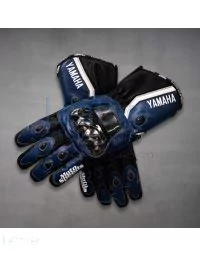
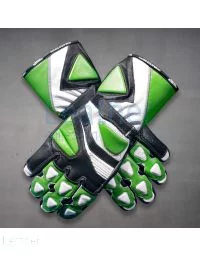
Most riders fit standard sizes. Custom gloves are worth considering if the hands are unusually narrow or wide for their length, if standard sizes create pressure points, or if the gloves need to match a custom racing suit. Riders ordering a suit such as the often choose gloves to match it, and the range shows what a complete setup can look like.
Riders who want protective gear for track and road use can explore the
for gloves designed around safety, fit and racing performance.For a closer look at how armor placement, reinforced construction and fit work together, the
is a useful reference.Care and Replacement
Follow the care label or the maker's instructions; the right cleaning method depends on the leather finish and lining. Before each ride, check for torn seams, loose armor or worn padding. After a crash, follow the maker's guidance on whether the gloves should be replaced.
Final Buying Advice
Three decisions matter most: the protection level that suits the riding, the fit, and the leather and construction. Make them in that order, and treat fit as the deciding factor.
Frequently Asked Questions
What is the difference between Level 1 and Level 2 motorcycle gloves?
Under EN 13594:2015, Level 1 gives protection with low ergonomic penalties, while Level 2 provides greater protection. Knuckle impact protection is optional on Level 1 and mandatory on Level 2, and the minimum cuff length is 5 mm for Level 1 and 50 mm for Level 2. Level 2 gloves can be heavier or more restrictive.
How should racing gloves fit?
Racing gloves should feel snug without causing numbness or pressure points. The palm leather should lie flat without bunching, the fingertips should reach the end of the fingers, and the wrist closure should hold the glove firmly in place. Holding the gloves on the handlebar for a few minutes shows quickly whether the fit works.
Should street gloves be used for track days?
Street gloves balance protection with ventilation and comfort, while racing gloves prioritize protection with thicker leather, more armor and stronger stitching. Track days also have their own rules, so the event organizer should be asked about glove requirements. Race-specific gloves are the usual choice for track use.
Are custom racing gloves worth it?
Standard sizes work for most riders. Custom gloves are worth considering if standard sizes keep creating pressure points or loose areas, or when gloves need to match a custom racing suit. Checking the fit of a standard glove against the criteria above is the first step before choosing custom sizing.
Written by the Leather Collection Editorial Team.