 Canada
  Brazil
  Germany
  France
  Italy
Italy  Switzerland
  Sweden
  Spain
Spain  Great Britain
  Norway
  Russia
  South Africa
  Japan
Japan  New Zealand
  Australia

A leather jacket can stay in use for many years, but how many depends on the grade of the leather, the hide it comes from and how the jacket is stored and cleaned. No single number fits every jacket, so this guide explains what to look at before buying and how to care for the jacket afterwards.
Key Takeaways
- Leather lifespan depends on grade, hide type and care; no single number applies to every jacket.
- Full-grain leather keeps the whole grain layer and develops a patina; "genuine leather" is not a specific grade.
- Bonded leather is made from shredded fibers and a binder and can flake after a few years.
- Care as the maker advises, correct hanging and keeping the jacket away from heat and damp protect the leather.
What Leather Actually Is
Leather is animal hide that has been tanned so it no longer decays. Tanning stabilizes the collagen in the hide. The oldest method uses plant tannins (vegetable tanning), while chrome tanning uses chromium sulfate and is the fastest industrial method, as Wikipedia explains.
The Layers of a Hide
A hide has more than one layer, and which layers end up in a jacket changes how it ages.
- Grain: the outer layer, with finer and more densely packed fibers, which gives strength and durability.
- Corium: the more fibrous layer underneath. Split leather is made from the corium left after the grain has been separated.
Real or Fake?
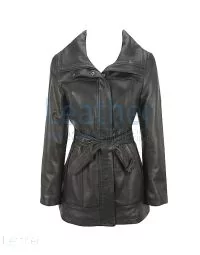
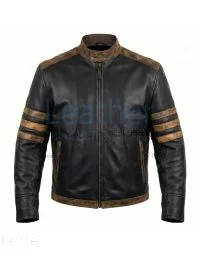
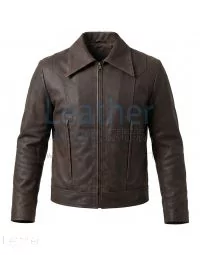
What looks like a stylish may or may not be real leather, so it pays to read how the material is described. Some jackets use synthetic or composite materials, and some terms on labels are less clear than they sound.
Whatever the style, from a to , the same questions apply: which hide, and which grade.
Leather Grades Compared
Full-Grain Leather
Full-grain leather contains the entire grain layer, with no removal of the surface. It develops a patina over its useful life, and marks and natural variation stay visible. Because the surface is not sanded away, it is the grade most associated with durability.
Top-Grain and Corrected-Grain Leather
Top-grain leather is made from the outer layer of the hide, sometimes with part of the corium. Corrected-grain leather has the surface treated with finishing steps to create a more uniform look. The result looks even and is easy to color, but the finish can hide natural character.
Genuine Leather
The term "genuine leather" does not describe a specific grade. It often indicates split leather that has been extensively processed, so a label saying only "genuine leather" tells a buyer little about quality.
Bonded Leather
Bonded leather is made from shredded leather fibers mixed with natural rubber or a polyurethane binder on a backing. Wikipedia notes that the surface of lower-quality bonded leather can flake in as little as a few years and is difficult or impossible to repair.
Types of Animal Hide
Grade describes how the hide was processed; the animal changes the feel and weight. Cattle supply the largest share of leather, followed by sheep, goats and pigs.
Cowhide
Cowhide is the most common jacket leather and is used from heavy motorcycle jackets to fashion styles.
Goatskin
Goatskin is another common choice for jackets, boots and other goods and is often chosen when a lighter jacket is wanted.
Sheepskin and Lambskin
Sheepskin is soft and is used for cold-weather clothing. Jackets with a shearling or fur lining are sold as their own group, such as .
Pigskin
Pigskin is used for clothing and gloves and is less common in jackets than cow, goat or sheep.
How Long Do Leather Jackets Last?
Leather that is looked after can last for decades, according to Wikipedia, but a jacket's real lifespan depends on the points above and on how it is used. A jacket worn daily in rain and sun ages faster than one worn occasionally and stored with care. Composite materials such as bonded leather are the exception: they can start to flake after only a few years.
How to Make a Leather Jacket Last Longer
1. Do Not Fold It
Folding creates creases that do not always relax. Store the jacket on a wide, shaped hanger so the shoulders keep their form.
2. Watch Temperature and Humidity
Heat dries leather and damp invites mold, so a cool, ventilated place is better than a hot attic or a humid basement. Over time, the wrong conditions can shorten the life of your .
3. Follow the Care Instructions
Follow the care label or the maker's instructions; the right conditioner or oil depends on the finish and construction of the leather. Test any product on a hidden spot first.
4. Keep It Out of Direct Sun and Heat
Direct sunlight and radiators dry leather out. If the jacket gets wet, let it dry naturally at room temperature rather than next to a heat source.
5. Clean It Regularly
Wipe off dust with a soft cloth; clean and condition only as the care label or maker advises. Regular light cleaning prevents grime from working into the surface.
Final Thoughts
A leather jacket lasts longest when the leather is a solid grade, the hide suits the use, and the owner stores and cares for it as the maker advises. Reading the label carefully and knowing what "full-grain", "corrected-grain" and "genuine leather" mean makes the buying decision easier.
Frequently Asked Questions
How many years does a leather jacket last?
There is no fixed number. Leather that is cared for can last for decades, but the result depends on the grade, the hide, how often the jacket is worn and how it is stored and cared for. Bonded leather is the exception and can start to flake after a few years.
Is genuine leather real leather?
Yes, it is made from real hide, but the term does not describe a specific grade. It often indicates split leather that has been extensively processed. Full-grain and top-grain leather keep more of the strong outer layer, so those terms say more about quality than the words genuine leather.
What is the difference between full-grain and top-grain leather?
Full-grain leather keeps the entire grain layer with no removal of the surface and develops a patina over time. Top-grain leather is made from the outer layer but may be sanded or finished to look more uniform, which can hide natural marks.
How should a leather jacket be stored?
Hang it on a wide, shaped hanger in a cool, dry and ventilated place, away from direct sunlight and heat. Avoid folding it, because creases may stay. Follow the care label or the maker's instructions for cleaning and conditioning.
Written by the Leather Collection Editorial Team.