 Canada
 Brazil
 Germany
 France
 Italy
 Switzerland
 Sweden
 Spain
 Great Britain
 Norway
 Russia
 South Africa
 Japan
 New Zealand
 Australia

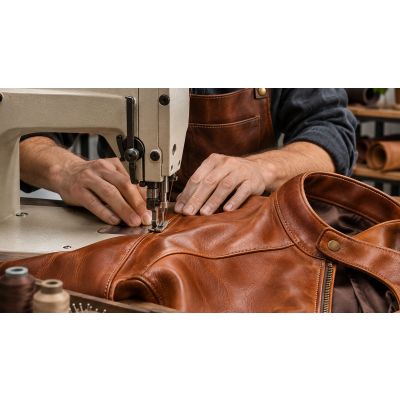
Short answer: leather is animal hide that has been cleaned, tanned so it stops rotting, dyed and finished. At the garment stage the finished hide is inspected, cut into panels, stitched and finished by hand, and that is where fit and durability are largely decided. The steps below follow one hide from the raw material to a finished jacket.
The five stages in short
- Raw hide and preservation. Hides arrive from the meat industry and are cured so they do not decay.
- Beam house. The hide is soaked, limed, de-haired and cleaned down to the fibrous structure.
- Tanning. Chemicals or plant tannins bond with the collagen fibers, turning a perishable hide into stable leather.
- Dyeing and finishing. The leather is softened with oils, colored, dried and given a surface finish.
- Making the garment. The finished hide is inspected, cut, stitched and checked.
From hide to raw material
Most leather starts as a by-product of the meat industry: the animal is raised for food, and the hide would otherwise be waste. That description is widely used by industry bodies and in reports on the sector, though it simplifies a more complex market, where hide value affects the economics. We do not make claims about the origin of any particular hide unless we can confirm them.
Raw hide begins to spoil within hours, so it is preserved soon after the animal is processed, commonly by salting, and sent to a tannery. Cattle, sheep, goats and pigs are the common sources for clothing.
The beam house and tanning
Liming and fleshing
At the tannery the hide is soaked to rehydrate it and wash off salt and dirt. It is then treated in an alkaline bath, usually with lime, to loosen hair and open up the fiber structure. The hair is removed, and a fleshing machine strips fat and flesh from the underside. The hide is then neutralized in a step called deliming, and may be treated with enzymes to relax the fibers.
Chrome tanning vs vegetable tanning
Tanning is the step that turns hide into leather. It cross-links the collagen so that the material no longer rots and no longer dries to a hard board. Two methods dominate.
| Chrome tanning | Vegetable tanning | |
|---|---|---|
| Agent | Chromium salts | Plant tannins from bark, wood or leaves |
| Speed | Fast, often a day or so in the drum | Slow, often weeks |
| Feel | Soft, stretchy, even | Firmer, fuller, less stretch |
| Color and aging | Takes color evenly; keeps its look | Natural tone that darkens into a patina |
| Heat and water | Better tolerance of both | Can shrink in hot water and stiffen |
| Typical use | Most garment leather | Belts, saddlery, some bags and footwear |
The choice shows up in the garment. A chrome-tanned hide makes a soft jacket that moves easily, while a vegetable-tanned hide makes a stiff piece that ages differently. Many leathers combine methods. The technical detail comes from standard leather technology texts and tannery trade bodies, which are the right place to check specifics.
Dyeing, fat-liquoring and finishing
After tanning, the leather is wrung out and split to an even thickness. It then goes into a drum with dyes and with oils or fats in a step called fat-liquoring, which lubricates the fibers and sets the final softness. The leather is dried, staked or milled to loosen the fibers, and given a surface finish.
- Aniline. Transparent dye, natural grain shows, less protective.
- Semi-aniline. A thin pigment coat, some grain shows.
- Pigmented. An opaque coating, even color, more durable surface.
- Embossed or corrected. A pattern pressed into the surface to give a uniform grain.
These finishes explain why two leathers of the same animal can feel and wear differently. Our post on full-grain vs top-grain leather covers how finish and grain layer go together, and genuine leather labels explained shows how marketing language maps to these terms.
From finished hide to jacket: the workshop steps
The tannery hands over a finished hide. What happens next is the part that decides fit. In general, making a leather jacket follows a sequence like this.
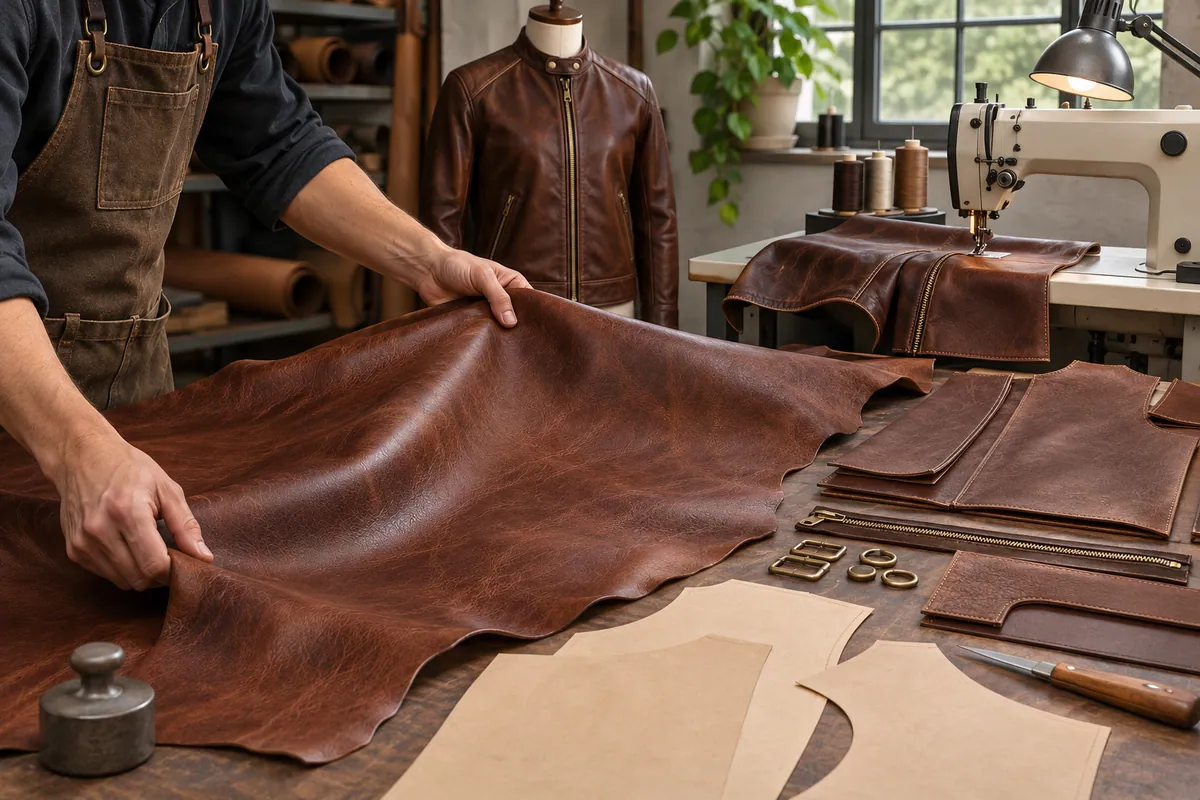
- Inspection. Each hide is checked for thickness, color consistency and marks. Natural variation such as healed scars is normal, and flaws in critical areas are avoided.
- Marking. Pattern pieces are placed on the hide so that grain direction and stretch run the right way, and so that panels that sit next to each other match.
- Cutting. Panels are cut, by hand or machine, to the pattern for the chosen size or measurements.
- Stitching. Panels are sewn with thread and seams suited to leather, with reinforcement at stress points.
- Hardware and lining. Zippers, snaps and linings are added.
- Final check. The garment is checked against the specification before it ships.
For the maker's own account of the process, read how our custom leather clothing is made, which this article does not try to repeat, and what happens after you place a custom leather order for the order timeline.
Why cutting is the quiet skill
Leather is not like cloth. A hide has an irregular outline, thinner areas along the belly and flanks, and a direction in which it stretches more. A cutter decides which part of the hide each panel comes from. Panels that take load, such as the back and shoulders, go on the strongest, most even part. Panels that sit side by side are cut from neighboring areas so the grain and shade match. Stretch direction is lined up so the garment gives where the body moves and holds where it should not.
This is also why leather cost is not only about the material. A careful cutter wastes more of the hide to get a better-matched garment, and that choice is invisible on the finished jacket but visible in how it wears.
How process choices show up in the jacket
- Thickness. Split to a chosen thickness at the tannery, it decides how stiff or drapey the jacket is.
- Softness. A product of the tanning, the fat-liquoring and the mechanical softening.
- Color consistency. Dyeing is done in batches, so two hides from different batches can differ slightly. Good cutting puts matching hide next to matching hide.
- Aging. Lightly finished leather develops a patina, and heavily coated leather ages by wearing at the surface.
How the animal changes the leather
The species sets the starting point before any tanning happens, because the fiber structure differs.
| Source | Typical character | Common garment use |
|---|---|---|
| Cattle (cowhide) | Thick, dense, durable, available in large pieces | Motorcycle jackets, race suits, coats, bags |
| Sheep and lamb | Thin, soft, drapey | Fashion jackets, blazers, gloves |
| Goat | Fine, tight grain, light and flexible | Gloves, some jackets |
| Kangaroo | Very thin and fine-fibered for its strength | Race gear, gloves |
That is why a motorcycle jacket is usually cowhide and a fashion blazer is often lambskin. See the comparison in different types of leather explained.
A short glossary of the terms you will see
- Grain. The outer layer of the hide, with the finest fibers.
- Corium. The thicker, looser layer beneath the grain.
- Split. A layer separated from the grain, often used for suede.
- Fat-liquoring. Adding oils back into the leather to keep fibers soft.
- Patina. Gradual change in tone and shine from use.
- Corrected grain. A surface sanded and embossed to look even.
What to look for as a buyer
Natural marks, such as small scars, fine wrinkles and slight variations in tone, are not defects. They show the surface is real hide and was not completely sanded and covered. What counts as a defect is damage that affects strength or looks unintended: thin spots, loose areas, open scratches at stress points. Labeling matters too, so read the leather description on the product page. If you want to see the finished result, browse our custom leather jackets, and compare the wider types of leather.
Environmental and ethical questions
People ask fair questions about leather. Here are honest answers without claims we cannot back.
- Is it a by-product? Mostly, in the sense that hides come from animals raised for meat. The industry and the market for hides are linked.
- Is tanning polluting? Tanning uses water and chemicals, and how well a tannery manages them varies by tannery and by country. Certification schemes and local regulations exist, but we do not claim any for our hides.
- Is vegetable tanning cleaner? It uses natural tannins, but it is slower and still uses water and energy, so it is not simply better or worse. The right answer depends on how each tannery operates.
We recommend asking any maker what it knows about its hides' origin, and reading independent sources, such as industry-body reports, rather than taking a slogan at face value.
FAQs
How long does it take to make leather?
It depends on the method. Chrome tanning can take days from raw hide to finished leather, while vegetable tanning can take weeks or longer.
What is the difference between chrome-tanned and vegetable-tanned leather?
Chrome-tanned leather uses chromium salts and is softer, more stretchy and quicker to make. Vegetable-tanned leather uses plant tannins and is firmer, slower to make and develops a patina.
Is leather a by-product?
Mostly. Most hides come from animals raised for meat, though the value of hides is part of the overall economics.
How is a leather jacket made?
The finished hide is inspected, panels are marked and cut, then stitched with hardware and lining, and the finished jacket is checked.
What are the stages of leather production?
Preservation, soaking and liming, fleshing, tanning, dyeing and fat-liquoring, drying and finishing.
Is leather made from animal skin only?
Yes. Leather is animal hide or skin. Materials made from plastic or plant fibers may be sold as leather alternatives, but they are not leather.
To see how a finished hide becomes a jacket cut to your measurements, explore our custom leather jackets.