
 Canada
 Brazil
 Germany
 France
 Italy
 Switzerland
 Sweden
 Spain
 Great Britain
 Norway
 Russia
 South Africa
 Japan
 New Zealand
 Australia

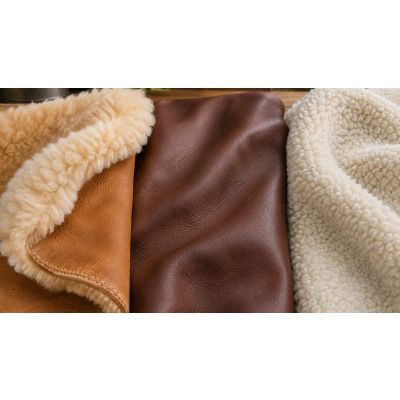
Short answer: Shearling is sheepskin tanned with the wool still attached. Sheepskin leather may have the wool removed. Sherpa is a fabric that imitates the look of shearling. To tell them apart, read the label and look at the skin side and the backing.
The three terms in one table
| Term | What it is | Warmth | Cost | Care |
|---|---|---|---|---|
| Shearling | Sheepskin tanned with the wool left on; one side leather, one side wool | Very warm; breathes | Higher | Specialist cleaning is usual |
| Sheepskin | The skin of a sheep; may be sold with wool on or with it removed as a leather | Depends on whether wool is present | Medium to high | Leather care; wool-on needs extra care |
| Sherpa | A knit or pile fabric, often polyester, that looks like wool fleece | Warm; holds less moisture well | Lower | Often machine washable if labeled |
| Faux shearling | Man-made pile fabric on a backing, made to look like shearling | Warm, varies | Lower | Check the label |
The relative ratings are general. Quality varies by product.
What shearling is
Shearling is a sheepskin that has been tanned and processed with the wool left on. The skin side becomes leather or suede, and the wool side is trimmed to a short, even length. That gives you two surfaces from one piece: the leather on the outside, and the wool inside, against your body.
There are two common forms. A jacket can be made with the wool on the inside and leather outside, which is the classic coat. Double-faced shearling has wool on both sides and a finished surface on one, used for collars and trim. Because the skin and the wool are one piece, shearling is warm and breathes better than most fabrics.
Sheepskin vs shearling
The two terms overlap. Shearling is a kind of sheepskin. Sheepskin is the broader term. It can mean the whole skin with wool on, or a leather made from the skin with the wool removed, which is used for soft, light jackets. Marketing blurs the line, so a listing that says "sheepskin" may mean either. If warmth from the wool matters to you, ask directly whether the wool is attached.
For how sheepskin compares with cowhide as a leather, see sheepskin vs cowhide.
Sherpa and faux shearling
Sherpa is a fabric. It is usually a knitted or woven base with a textured pile, made to resemble sheep wool. Faux shearling is a similar idea, with a man-made pile intended to imitate shearling, sometimes bonded to a backing that looks like suede. Neither contains a sheepskin.
Expect a lower cost, easier care and a similar look from a distance. Expect less breathability, because man-made pile traps moisture, and less durability in the pile, which can mat over time.
How to tell real shearling from faux
- Read the label. Look for wording such as "sheepskin", "shearling" or "genuine shearling" versus "faux", "polyester", "acrylic" or "man-made".
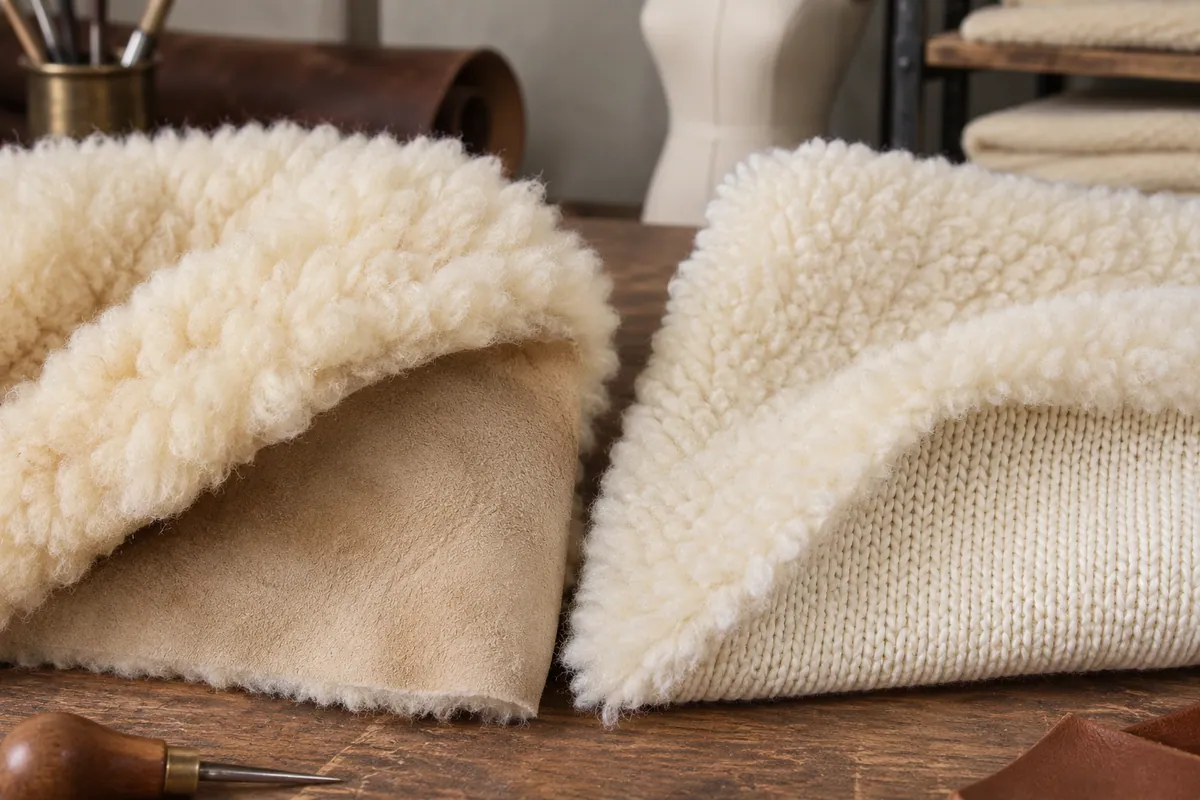
- Check the skin side. On real shearling, you can see a leather or suede surface with natural variation, with fibers that grow through the wool. Faux has a woven or knit backing with an even, regular texture.
- Part the fibers. Real wool grows from the skin at slightly different lengths and angles. Faux pile sits in neat, uniform rows on a fabric base.
- Look at the seams and edges. Real shearling is stitched edge to edge through skin. Faux shows a fabric edge that can fray.
- Consider price. Real shearling is costly. A very low price points to faux, though a high price does not prove it is real.
You may see a burn test suggested online. We do not recommend it; it damages the garment and is unreliable and unsafe. Use the label and the skin side instead.
How warm is each?
Real shearling is warm because the wool traps air and moves moisture away from the body, and the leather outer cuts wind. It stays comfortable across a wide range of temperatures. It does not like being soaked, and wet shearling dries slowly. Sherpa and faux shearling feel warm quickly but can feel clammy if you sweat, and they offer less wind resistance unless the outer layer provides it. For how leather jackets handle cold, see do leather jackets keep you warm?.
Choosing a shearling-lined jacket
- Allow for bulk. The lining adds thickness at the chest, arms and shoulders. Check the size chart and consider your usual layers.
- Check sleeve and shoulder room. A heavy lining makes sleeves feel tighter.
- Ask about the lining. Confirm whether the lining is real shearling, a sheepskin lining or faux fur. Check the product page; ours lists the lining.
- Plan the care. Wool-lined garments need specialist cleaning, and water can mark the outer leather.
Our brown sheepskin fur-lined zipper jacket is a lined option. Its lining is faux fur by default, and you can choose lambskin shearling in the Fur Type option when you order. The men's leather coats collection has other warm styles. If you already own a lined jacket, read how to wash a leather jacket with a fur lining, and for the range of hides see different types of leather explained.
Fur-lined jackets: why the descriptions vary
People search for a fur-lined jacket, a leather jacket with fur inside or a jacket with a fluffy lining, and the products that come up use all kinds of words: shearling, sheepskin, faux fur, sherpa, fleece. They are not interchangeable. A jacket described as "fur-lined" might have a real wool-on-skin lining, a man-made pile, or a fabric lining that only looks warm. The term says little about what is inside, so rely on the material line of the product page and the label, not the headline.
A good product page should say what the lining is made of, and what the outer is. If it does not, ask before you buy. Leather Collection product pages state both.
A buying checklist for lined jackets
| Check | Why it matters |
|---|---|
| Lining material named on the page | Real shearling, sheepskin lining, faux fur and sherpa differ in warmth and care |
| Outer material named | The outer leather decides wind resistance and wear |
| Size chart and layers | Lining adds bulk; thick sweaters may not fit |
| Care instructions | Wool-lined garments usually need specialist cleaning |
| Seam and edge finish | Edges should be stitched through, not just glued |
| Price against the claim | Very low prices rarely go with real shearling |
Looking after real shearling
If your jacket does have a wool lining, a few habits help it last. Brush the wool gently when dry to keep it from matting. Blot spills at once and do not rub. Let a damp jacket dry slowly at room temperature, away from heat, because heat can harden the skin. Store it on a wide hanger in a ventilated space, not in a sealed bag. For heavier cleaning, use a specialist who handles shearling, since household washing methods can ruin the skin and the wool. If a lining carries a smell, see how to get smells out of a leather jacket.
When shearling is not the right choice
If you live somewhere mild, a shearling-lined jacket will be too warm for most of the year. If you want an easy-care jacket, faux is simpler to look after. And if animal products are a concern for you, choose a faux or synthetic lining and read labels carefully, because marketing terms can mislead.
FAQs
Is shearling real sheep?
Yes. Shearling is sheepskin tanned with the wool on. Fabrics that imitate it are not.
Is shearling warmer than leather?
Generally yes, because the wool traps air against the body. A leather jacket without lining is cooler.
What is the difference between sherpa and shearling?
Shearling is a real sheepskin with wool. Sherpa is a fabric made to look like wool fleece.
How do you tell real shearling from fake?
Check the label, look at the skin side for natural leather or suede, and look at how the fibers grow. Faux has a fabric backing and a regular texture.
How do you clean a shearling jacket?
Usually with specialist cleaning. Brush light dirt, blot spills and avoid soaking. Check the care label first.
See the lined option at brown sheepskin fur-lined zipper jacket.