 Canada
 Brazil
 Germany
 France
 Italy
 Switzerland
 Sweden
 Spain
 Great Britain
 Norway
 Russia
 South Africa
 Japan
 New Zealand
 Australia


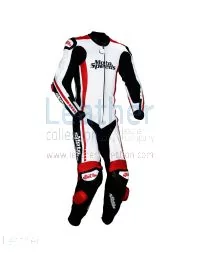
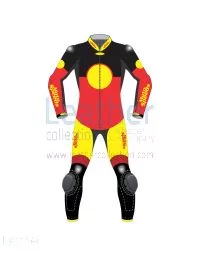
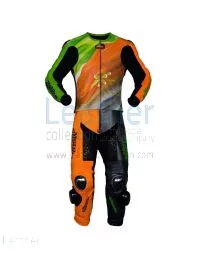
A one-piece or two-piece leather suit covers the shoulders, torso, hips and legs in one continuous layer, which is why it is the usual choice for track days and sport riding. The is a made-to-order cowhide suit with a classic race cut, removable armor and options for one-piece or two-piece construction.
Key Takeaways
- The shell is 1.2 to 1.3 mm drum-dyed milled cowhide with double and triple stitched main seams.
- The product page lists removable CE Level 2 armor (EN 1621-1:2012) at the shoulders, elbows, knees and hips.
- It is offered as a one-piece or a two-piece suit, with a removable lining and replaceable TPU knee sliders.
- EN 17092 grades the garment, with Class AAA intended for racetrack leather suits; always check the label of the exact suit.
Why Riders Choose a Full Leather Suit
A suit joins the upper and lower body into one coordinated set. The one-piece format has the fewest seams and joins, while a two-piece suit zips or snaps the jacket to the pants and can be worn separately. The range shows the typical formats and cuts.
Typical users are:
- Track-day riders
- Sportbike riders on twisty roads
- Riders who want one coordinated set of leather instead of separate pieces
Materials and Construction
According to the product page, the suit uses:
- 1.2 to 1.3 mm drum-dyed milled cowhide, with Monaco leather or kangaroo leather as optional upgrades
- Stretch inserts at the joints (the page lists DuPont Kevlar stretch inserts)
- High-strength bonded nylon thread, with double and triple stitching on the main seams
- YKK semi auto-lock coil zippers
- A detachable, washable lining with mesh at the underarms and torso, and an optional thermal lining
Armor and Sliders
The suit takes removable CE Level 2 armor to EN 1621-1:2012 at the shoulders, elbows, knees and hips. A spine protector compatible with EN 1621-2 can be fitted, and the TPU knee sliders are replaceable between track sessions. Armor is only useful if it stays over the joint, so the made-to-measure sizing matters as much as the armor itself.
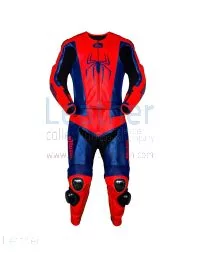
Riders who want a pair of independent pieces can compare the range, or look at a different cut such as the .
What EN 17092 Tells a Rider
EN 17092 grades riding garments from Class AAA to Class C. Class AAA is the highest and is intended for one- and two-piece leather suits for the racetrack, Class AA and A offer progressively less protection, and B and C are lower still, according to MCG product compliance. The product page does not state an EN 17092 class for this suit. The class belongs on the garment label, so riders should confirm what the specific suit documents rather than infer it from the armor.
Final Thoughts
The Veteran suit is a straightforward cowhide race suit with removable armor, replaceable sliders and a choice of one- or two-piece construction. Riders should choose it for fit and construction first, and treat the armor and standards as the part to confirm on the label.
Frequently Asked Questions
Is the Veteran suit available as one piece and two pieces?
Yes. The product page lists a one-piece or a two-piece configuration. The two-piece version uses silver snap buttons on the pants so the jacket and pants can be joined or separated, which suits riders who sometimes want to wear only one half of the suit.
What armor does the suit include?
Removable CE Level 2 armor to EN 1621-1:2012 at the shoulders, elbows, knees and hips, per the product page. A spine protector compatible with EN 1621-2 can be fitted, and the TPU knee sliders can be replaced when they wear.
What does Class AAA mean?
Class AAA is the top class of EN 17092 for riding garments and is intended for racetrack leather suits. It applies to the garment itself, so check the documents of the exact suit rather than assuming a class.
Can it be worn for road riding?
Yes, many riders use race-cut leather suits on the road as well as at track days. The cut is shaped for a forward riding position, so riders who sit upright should consider the fit and the ventilation options.
Written by the Leather Collection Editorial Team.