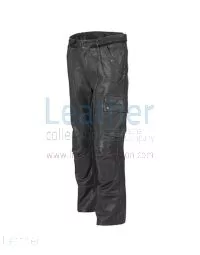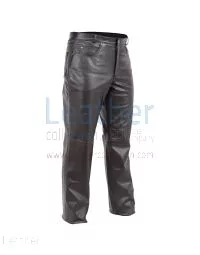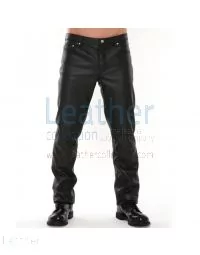
 Canada
  Brazil
  Germany
  France
  Italy
Italy  Switzerland
  Sweden
  Spain
Spain  Great Britain
  Norway
  Russia
  South Africa
  Japan
Japan  New Zealand
  Australia

Leather pants are a staple of motorcycle gear. Whether the aim is track-style protection or everyday riding, come in cuts and constructions for different needs. This guide covers why riders choose custom-made pants, which features matter and how to look after them.
Key Takeaways
- Custom-made pants are cut to supplied measurements, so the fit can be matched to the rider and the bike.
- Knee armor pockets, reinforced panels and stretch or ventilation zones matter more than looks.
- EN 17092 is the standard that assigns motorcycle clothing to protection classes.
- Follow the care label for cleaning and conditioning, and store leather pants in a dry place.
Why Choose Custom-Made Men's Leather Pants?
Pants made to order are produced from the measurements the rider supplies, which is the main advantage over off-the-shelf sizes. Leather Collection has hand-stitched gear to order since 2009. Typical benefits include:
- Fit: pants cut to the rider's measurements are less likely to bunch at the knee or pull at the waist in the riding position.
- Personalized design: leather type, stitching color and features such as knee armor pockets and ventilation can be chosen.
- Material choice: cowhide is a common leather for riding pants because of its abrasion resistance.
- Comfort on long rides: pants designed around the rider's dimensions and with flex or ventilation zones are easier to wear for hours.
Key Features to Look for
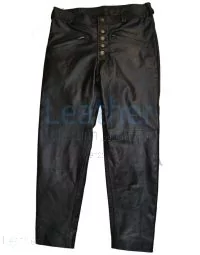
- Fit and cut: slim, straight and bootcut styles exist. The waist, thighs and calves should be snug but not restrictive. A good starting point is the .
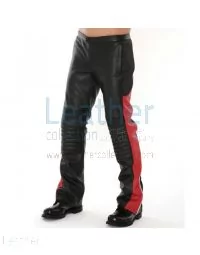
- Protection features: reinforced knee panels, abrasion-resistant leather and pockets for armor inserts. For track-style riding, see the .
- Breathability: ventilation zips or perforated leather help on warm days.
- Customization: colors, stitching and hardware can usually be specified, from classic black to red or brown.
- Mobility: stretch panels at the knees and waist make it easier to move on the bike.
Understanding the Protection Standard
EN 17092 is the European standard for motorcycle riding clothing. According to SATRA, it sets requirements for garments in classes AAA, AA, A, B and C. Class AAA gives the highest level of protection, with one-piece and two-piece suits as examples, and impact protectors are mandatory in Class AAA and AA garments. Class B gives abrasion protection equivalent to Class A but without impact protectors, and Class C is designed only to hold impact protectors and has no minimum abrasion protection. Regulation (EU) 2016/425 on personal protective equipment has applied since 21 April 2018 (EUR-Lex). A class applies only to a garment that has actually been tested, so riders should check the stated class of a specific item rather than assume it from the material. Riders who prefer leg protection that leaves the seat open can look at .
How to Care for Custom Leather Pants
Follow the care label or the maker's instructions. The right conditioner or water-repellent treatment depends on the leather's finish and construction; test it on a hidden area first. Care for custom like this:
- Clean after rides: wipe off dust and dirt with a damp cloth. For deeper cleaning, use a leather cleaner intended for riding gear.
- Condition: follow the care label or the maker's instructions on whether and how to condition, and test on a hidden area first.
- Avoid sun and heat: store them in a cool, dry place out of direct sunlight, which can fade and dry out leather.
- Water protection: leather is not waterproof. If a water-repellent treatment is used, choose one suited to the leather's finish.
Frequently Asked Questions
How are custom-made leather pants measured?
They are made from measurements the rider supplies, typically waist, hips, inseam and thigh. Knee height matters for armor placement, so measuring in a riding position helps. Accurate figures reduce the need for alterations and keep the knee protectors aligned with the knee.
What does EN 17092 mean for leather pants?
EN 17092 is the European standard for motorcycle clothing. It assigns classes AAA, AA, A, B or C with different requirements, AAA being the highest level of protection, and class B and C garments are designed differently from the others. A class belongs only to a garment tested to it, so check the stated class of the exact item.
Can leather pants be worn in the rain?
Leather is not waterproof. Light rain is manageable, but heavy rain soaks through. Water can also stain or stiffen some finishes, so check the care label for how the pants should be treated and dried. If pants get wet, dry them naturally away from direct heat and follow the care label on conditioning.
What armor goes in leather pants?
Most riding pants have pockets that take knee armor, and some also take hip armor. The inserts are sold separately or fitted when ordered. Armor should sit over the kneecap in the riding position, which is why accurate measurements matter.
Written by the Leather Collection Editorial Team.