 Canada
 Brazil
 Germany
 France
 Italy
 Switzerland
 Sweden
 Spain
 Great Britain
 Norway
 Russia
 South Africa
 Japan
 New Zealand
 Australia


Short answer: a stiff leather jacket or vest softens fastest by being worn and moved in, ideally in the positions you will ride or work in, with a light conditioner at most. Thick cowhide vests take longer than jackets. Never soak, bake or blow-dry a stiff piece: water, heat and heavy oil are the three quickest ways to damage leather, and none of them fixes a wrong size.
Key takeaways
- Check the care label and the maker's instructions before you do anything to a new garment.
- Wearing and flexing the leather works best. Riding in it flexes it exactly where you move.
- Stiffness eases. Pinching, numbness or restricted breathing points to a sizing problem, not a break-in problem.
- Skip soaking, wearing it wet, oven heat, hair dryers and heavy oil.
Why new leather feels stiff
Leather is tanned animal hide. Tanning stabilizes the collagen fibers so the hide dries flexible instead of hard, and that is why leather can soften with use. How stiff a garment feels on day one depends on four things: how thick the hide is, how it was tanned, what finish sits on top, and how the garment is cut.
Thick cowhide and heavily coated finishes are stiffer than thin skins and lightly finished leather. Linings, armor pockets and panel seams add to the feeling. Our leather thickness guide explains why a heavier hide feels different from a lighter one, and why that is often a good sign rather than a defect.
Leather vests: why they feel stiffer than jackets
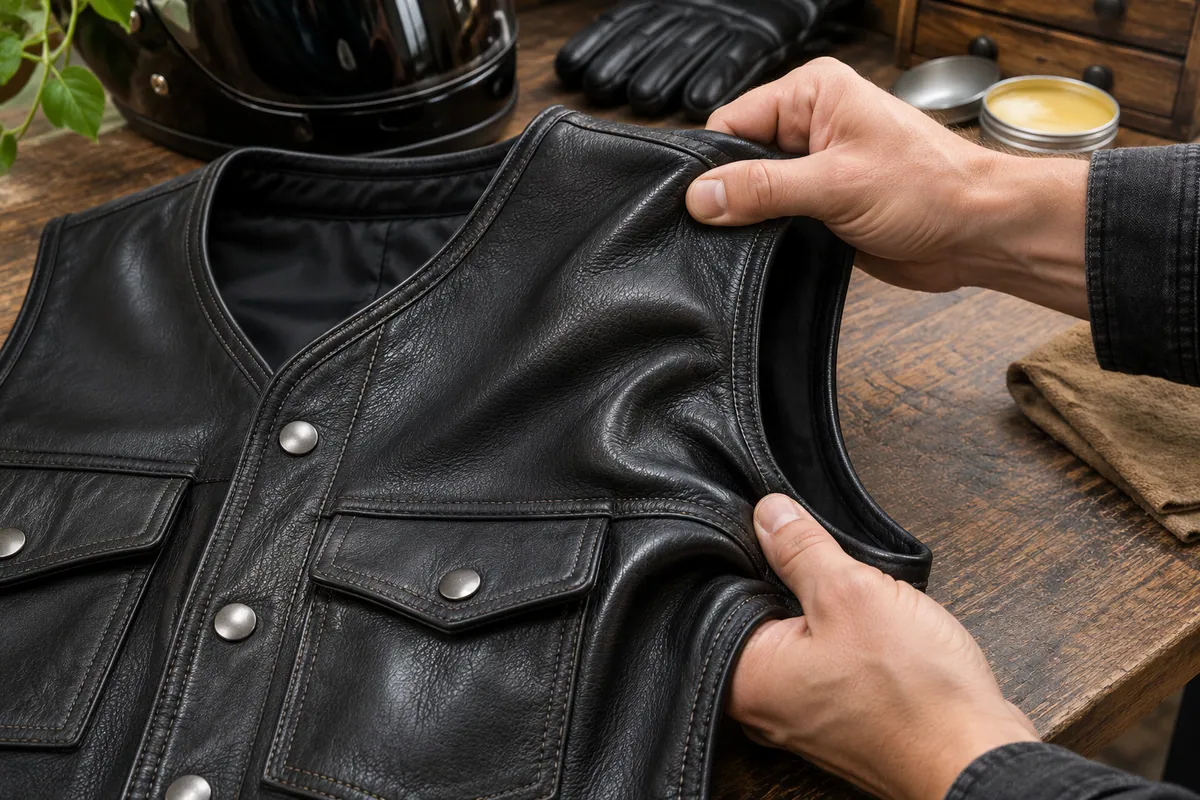
A club-style or riding men's leather vest is usually cut from thick cowhide and has no sleeves to share the load. Every flex is concentrated at the armholes, the shoulders and the front closure. Creases form there first, and the leather resists until those areas have been bent many times.
Fit changes the feel as much as the hide. A vest that is slightly narrow across the chest or shoulders will feel stiff and hold its shape against you; one that sits correctly lets the leather move. Before blaming the leather, check your measurements against a vest size chart. Our guide to measuring and choosing a leather vest size shows how, and our explainer on leather motorcycle vests for men covers how a vest is meant to sit over layers.
Breaking in by wearing versus conditioning
These two methods do different jobs, and it helps to know which one you want.
| Method | What it does | What it cannot do |
|---|---|---|
| Wearing and flexing | Bends the leather where your body moves, relaxes seams and lets panels settle to your shape | Fix a size that is too small |
| Riding in it | Same as wearing, but with the real shoulder, elbow and hip positions you use | Be safe to do in a garment that is pinching or restricting you |
| Light conditioner | Softens the surface and replaces some lost oils | Change how the whole thickness of the hide behaves |
Conditioner is optional and should be gentle. A small amount on a clean surface, tested on a hidden area first, is the cautious approach. Heavy oil softens more, but it also darkens leather and can loosen the fit. Our guide to cleaning and conditioning a jacket at home shows a light routine.
Methods to skip
Online advice for speeding up softening often involves water, heat or heavy products. Each carries real risk.
- Soaking or wearing it wet. Water can leave marks, strip finish and make leather stiff and dry as it dries. It is a known bad method, so treat it as a warning only. Vegetable-tanned leather in particular can shrink in hot water.
- Oven, hot car or radiator heat. Heat dries leather out and can make it brittle or cause it to shrink.
- Hair dryer. Concentrated heat marks and cracks the finish.
- Heavy oil. It darkens leather, can stain linings and may loosen fit more than you want.
- Stretching a too-small garment. Leather gives a little in the right places. It does not replace a correct size.
How long does break-in really take?
There is no honest fixed number. A thin jacket worn daily may feel comfortable in a few outings. A thick cowhide vest worn occasionally can take much longer. The pace depends on the thickness of the hide, the finish, the lining, how often you wear it and how the garment fits. Judge progress by comfort in the positions you actually use, not by a count of days.
A useful test is to sit, reach and raise your arms every few days. If the same spots pull less each time, break-in is working.
Jacket break-in: shoulders, elbows and collar
- Start indoors. Wear it around the house for short sessions with the layers you will have on underneath.
- Work the trouble spots. Roll your shoulders, bend your elbows and reach forward repeatedly. The collar softens as you turn your head and as it contacts your neck.
- Add short outings. Real movement does what no indoor routine can.
- Build up. Lengthen wear time gradually.
Sleeve length and shoulder width decide comfort long before softness does, so a jacket that is too tight in the upper arms is a fit question.
Race suit break-in
A race suit is cut for the riding position, so it often feels awkward standing upright. Practice the position on the bike, on its stand if possible: arms forward, knees tucked, back slightly rounded. Kneeling and crouching help the knee and hip panels settle. Go easy on oil, because a snug suit relies on a controlled fit, and follow the maker's care instructions. Browse our leather race suits to see the one-piece and two-piece formats, and read our leather gear care guide for general upkeep.
| Point | Leather jacket | Leather vest | Race suit |
|---|---|---|---|
| Main stiff areas | Shoulders, elbows, collar | Armholes, shoulders, front panels | Shoulders, elbows, hips, knees, back |
| Best approach | Wear with normal layers, then short rides | Wear often, check the size chart, flex the armholes | Practice the tucked riding position |
| Common problem | Tight upper arms | Narrow chest or shoulders | Pulling at crotch, knees or collar when upright |
When it will not soften
Normal break-in feels like resistance that eases. Warning signs are different: numbness in the arms, pressure that does not ease, difficulty taking a full breath, or armor sitting away from the joint it should cover. These point to the wrong size or cut, or in some cases leather too heavy for the use. Stop wearing it in that state and compare your measurements to the size chart. If the garment came from us and the sizing or workmanship is our error, we remake it free and pay shipping both ways. We do not alter garments after delivery.
Habits that help while it softens
Small routines make a difference. Wear the garment with the same layers you will use, because a thick sweater changes how the shoulders and chest feel. Take it off and hang it on a wide, padded hanger rather than folding it into a bag, so creases form where the body creates them and not where a fold does. Let damp leather dry naturally at room temperature, and keep it out of hot cars and away from radiators.
Expect creases. Fine lines at the elbows, armholes and across the back are part of how leather ages and show that the hide is flexing. Deep, dry cracking is different. If the surface looks parched or flaky, stop wearing it hard and ask the maker or a leather specialist what to do before applying anything.
Finally, give it time between sessions. Leather recovers slowly from being bent, so a few short, regular sessions do more than one long, uncomfortable day.
FAQs
How do I soften a stiff leather jacket?
Wear it often, flex it at the shoulders and elbows and ride in it if it is a riding jacket. Apply a light conditioner only if the care label or maker allows it. Avoid water, heat and heavy oil.
How long does leather jacket break-in take?
It varies with the hide, the finish and how often you wear it. Judge by comfort, not days. Thin leather eases sooner than thick cowhide.
How do I soften a stiff leather vest?
Wear it regularly, work the armholes and shoulders, and check that the size is right. Thick cowhide vests take longer than jackets, and riding in them breaks them in best.
Can I use conditioner to break in a jacket?
Lightly, yes, if the care label or maker agrees. Test on a hidden area first. Conditioner softens the surface but will not fix a wrong size.
Is wearing a leather jacket in the shower safe?
No. Soaking can stain, stiffen and dry out leather as it dries, and it is a popular myth, not a safe method.
Why is my new leather vest so stiff?
Vests are often made from thick cowhide with no sleeves to spread the stress, so the armholes and shoulders resist until they are flexed many times. A snug fit makes it feel stiffer.
Good cowhide softens with wear. If you are shopping for one, browse our men's leather vests.