
 Canada
 Brazil
 Germany
 France
 Italy
 Switzerland
 Sweden
 Spain
 Great Britain
 Norway
 Russia
 South Africa
 Japan
 New Zealand
 Australia

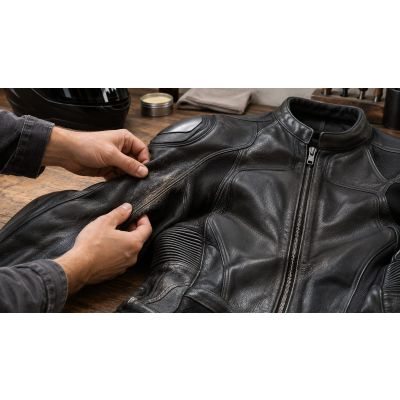
Short answer: after a crash, check yourself first, then inspect your gear. Small surface scuffs can sometimes be repaired, but split seams, deep or through-abrasion and armor that took an impact generally mean replacement. Ask the manufacturer, since only they know how the gear was built. This is general guidance, not a safety guarantee.
First steps after a crash
- Check yourself. Get medical attention if you have any doubt about injuries. Adrenaline hides pain.
- Do not ride the gear home if it is visibly damaged. A suit with a split seam or a torn panel offers less protection than it did.
- Take photographs of the gear as it is, before cleaning or repairing it.
- Keep everything, including the armor, and do not throw anything away until it has been assessed.
- Leave it to dry naturally if it is wet, away from heat.
Your gear has done its job once. The question now is whether it can do it again.
Inspection checklist
Go over the suit or jacket slowly, in good light, on a flat surface. Turn it inside out where you can.
| Part | What to look for | If you find it |
|---|---|---|
| Seams | Split stitches, open seams, thread pulled through the leather | Replace, or ask the maker whether it can be repaired properly |
| Leather surface | Scuffs, scratches, burn marks, flattened or glazed areas | Minor scuffs may be repairable; deep marks are a warning |
| Leather thickness | Thin spots, holes, a rough or fuzzy underside showing | Replace |
| Zips | Bent teeth, damaged slider, stiff action | Replacement zip by a specialist, if the surrounding material is sound |
| Armor | Cracks, crushed areas, dents, loose fit in the pocket | Replace armor that took an impact |
| Liner | Tears, burn marks, loose panels | Repair is possible; check what it does for protection |
| Stitching on stretch panels | Pulled threads, torn elastic | Repairable by a specialist if the seam is sound |
| Hump and back protector | Cracks, deformation, torn mounting | Replace damaged parts |
| Closures | Snaps, velcro, buckles that no longer hold | Replace |
Our guide to stitching in motorcycle race suits explains why seams matter as much as the leather.
What can usually be repaired
- Surface scuffs and light abrasion: a specialist can often colour and refinish them. They may still show, but the leather underneath is intact.
- Small seam repairs: a short, accessible open stitch on a non-critical seam can be restitched by a specialist who knows leather gear.
- Replaced zips and snaps: if the leather around them is sound.
- Liner damage: usually repairable because it is not the main protective layer.
- Cosmetic care: cleaning and conditioning, using our DIY leather repair guide for small marks.
If a repair is on a critical seam or a high-impact area, ask the maker first. A repair that looks tidy can still be weaker than the original construction.
What should be replaced
- Split or opened seams at the shoulders, elbows, hips and knees, which are the areas that take the most load.
- Thin, holed or through-worn leather, where the abrasion layer has gone.
- Armor that has taken an impact, even if it looks fine.
- Any airbag unit that has deployed, which needs servicing or replacement by the maker.
- Back protectors and humps with cracks or deformation.
- Gear that no longer fits properly after repairs.
Armor after an impact
Armor is designed to absorb energy once, by deforming or breaking up its structure. After an impact, it may have lost some of that ability even if it looks undamaged. Armor makers such as Knox say in their care guidance that a protector that has taken an accident impact should be replaced, and other makers give similar advice. Guidance differs by product, so check the maker's own instructions for yours. Read the label or instructions, and ask the maker if in doubt. For an explanation of armor standards, see our guide to CE armor.
Repair or replace: a decision table
| Situation | Usually | Why |
|---|---|---|
| Light scuff on a flat panel, no seam damage | Repair or leave | The leather is intact |
| One short open seam on a low-stress area | Repair by a specialist | Restitching can restore it |
| Open seam at shoulder, elbow or hip | Replace or ask the maker | High-load seam |
| Hole or thin patch in the leather | Replace | The protective layer has gone |
| Impacted armor | Replace the armor | May have lost its protection |
| Deployed airbag | Service or replace per the maker | Single-use system |
| Zip damage only | Replace the zip | The garment may be sound |
If the cost of repair approaches the cost of a new item, replacement is usually the better choice, since a new piece comes with new armor and a known specification.
Does Leather Collection repair suits?
Whether a particular piece can be repaired depends on the damage and how it was built. Leather Collection does not offer repairs, so ask a leather specialist about repair. If you need a replacement, our leather race suits and custom race suits are made to order, and Custom Size lets you order in your own measurements, with a design preview or sketch sent for your approval before the leather is cut.
How to check a seam properly
Seams are where gear fails, and damage is not always obvious. A useful way to check:
- Lay the suit on a flat, well-lit surface.
- Run your fingertips along each seam, feeling for gaps, loose stitches and raised thread.
- Pull gently on either side of the seam. It should not open or show a gap.
- Turn the garment inside out and look at the thread from the back, because wear shows there first.
- Check the stitching around the armor pockets, since armor movement can stress them.
A stitch that has been pulled flat or glazed by a slide has been weakened, even if it has not broken. If you can see daylight through a seam, or the leather around it has worn thin, do not rely on it.
What not to do
- Do not hide damage with glue or patches, and then ride on it.
- Do not clean aggressively with solvents, which can weaken leather and thread.
- Do not assume that a suit with no visible damage is unaffected. Impact can damage armor and stitching you cannot see.
- Do not sell or pass on crashed gear without saying it has been in a crash.
Insurance and documentation
If the crash involved a claim, documentation helps. Keep photos of the gear, receipts for the gear and for any repair estimates, and record where and when the crash happened. Some insurance policies cover riding gear and some do not, and the terms vary, so check your policy or ask your insurer directly. This is a general pointer, not insurance advice. Keep damaged gear until any claim has been settled.
Before you ride again
- Have the gear inspected by the maker or a leather specialist if there is any doubt.
- Replace armor that took an impact.
- Do not use a repaired garment for track riding until a specialist has checked the repair.
- Check that the fit is still correct. Repairs and shrinkage can change it.
Our checklist on how to tell if gear is built for real protection is a good companion when you are choosing a replacement.
Choosing a replacement
If your suit does need replacing, a crash is a good moment to rethink the specification. Ask yourself whether the fit was right, whether the armor level suited your riding, and whether you want to add features such as extra back protection or an allowance for your own airbag vest. A made-to-measure order lets you carry the lessons over: choose Custom Size and send your own measurements. Allow time for production, and do not ride in damaged gear while you wait.
FAQs
Can you repair a leather race suit after a crash?
Sometimes. Surface scuffs and short seam repairs can often be fixed by a specialist, but serious damage generally means replacement. Ask the manufacturer.
Should I replace armor after a crash?
Armor that has taken an impact should generally be replaced, even if it looks undamaged. Follow the armor manufacturer's guidance.
Can a leather suit be repaired after sliding?
That depends on how much leather has worn away. Deep or through-abrasion, or damaged seams, usually mean the suit should be replaced.
How do I know if my leathers are still safe?
Use the inspection checklist: seams, leather thickness, zips, armor and liner. If anything is doubtful, get a professional opinion before riding in them.
Is gear covered by insurance after a crash?
It depends on your policy. Check the terms or ask your insurer, and keep photos and receipts.
If your suit needs replacing, see leather race suits or custom race suits.